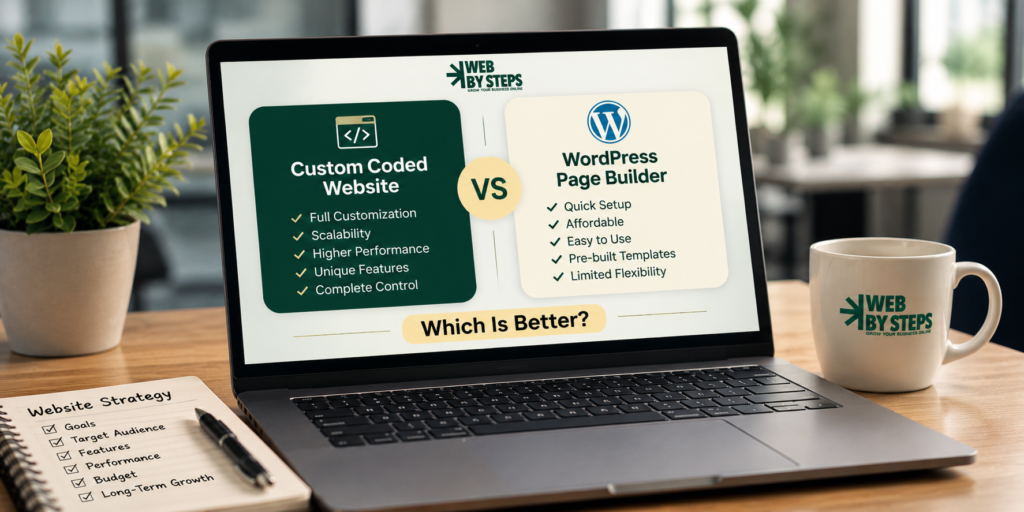
If you are planning to build a website, you have probably come across two common options: a custom-coded website and a WordPress website built with a page builder.
Both can create a professional-looking website. Both can be fast. Both can be optimized for SEO. And both can work extremely well when they are built properly.
So, which one should you choose?
The honest answer is: it depends on what your website needs.
A small business website, for example, may not need thousands of lines of custom code. On the other hand, a complex platform with unique features may quickly outgrow a typical WordPress page-builder setup.
At Web by Steps, we believe the right technology should support the business—not make the business adapt to the technology.
In this guide, we will compare custom-coded websites vs WordPress page builders in simple terms, including cost, speed, SEO, security, flexibility, maintenance, scalability, and long-term value.
Custom Coded Website vs WordPress Page Builder: Quick Comparison
Before going into detail, here is a simple overview:
| Factor | Custom Coded Website | WordPress + Page Builder |
|---|---|---|
| Initial Cost | Usually higher | Usually lower |
| Development Time | Longer | Faster |
| Design Flexibility | Very high | High |
| Custom Functionality | Excellent | Good to very good |
| SEO | Excellent when coded properly | Excellent when optimized properly |
| Performance | Potentially excellent | Depends on builder, plugins, and optimization |
| Maintenance | Requires technical knowledge | Easier for most users |
| Content Editing | Usually requires developer/CMS | Easy for non-technical users |
| Scalability | Excellent | Good to excellent, depending on setup |
| Plugins | Not always required | Often relies on plugins |
| Best For | Complex, unique, high-control websites | Businesses, blogs, portfolios, marketing websites |
The important thing to remember is that neither option is automatically better in every situation.
What Is a Custom Coded Website?
A custom-coded website is built specifically for a business or project using programming languages and frameworks such as HTML, CSS, JavaScript, PHP, Python, React, Next.js, or other technologies.
Instead of starting with a ready-made website template or page builder, developers build the website according to the project’s requirements.
For example, imagine a company wants a website with:
- A completely unique user interface
- A custom booking system
- Customer dashboards
- Complex calculators
- Integration with multiple third-party APIs
- Custom search and filtering
- Special user permissions
- A highly optimized web application
A custom-coded website may be a better fit for this type of project.
Example
Suppose you run an international logistics company.
You don’t just need pages like “Home,” “About,” and “Contact.” You may want customers to enter a tracking number, see shipment information, calculate shipping costs, compare delivery options, and manage their accounts.
A custom-built system can be designed around those exact requirements.
This is where custom development becomes particularly valuable.
What Is a WordPress Page Builder Website?
WordPress is a content management system (CMS) that allows people to create and manage websites without having to code everything from scratch.
A page builder adds a visual editing experience to WordPress.
Popular WordPress page builders include tools such as Elementor, Beaver Builder, WPBakery, and similar visual editors.
Instead of writing code for every section, you can visually create layouts using elements such as:
- Headings
- Images
- Buttons
- Forms
- Columns
- Testimonials
- Pricing tables
- Galleries
- FAQs
- Blog sections
For example, if you want to create a service page, you can often build the page by arranging sections visually instead of asking a developer to code every element.
This makes WordPress particularly attractive to small businesses, marketers, bloggers, agencies, and website owners who want to manage their own content.
1. Which Gives You More Design Freedom?
Custom Coded Website
Custom development gives you the highest level of design freedom.
A developer can create a design that is specifically built around your brand, audience, and business goals.
You are not necessarily restricted by the structure of a particular theme or page builder.
Want an unusual animation?
Need a completely custom navigation system?
Want a unique product configurator?
A custom website can be designed around those requirements.
WordPress Page Builder
Modern page builders are also surprisingly flexible.
For most business websites, you can create highly customized designs without writing much code.
You can change:
- Fonts
- Colors
- Spacing
- Layouts
- Buttons
- Animations
- Headers
- Footers
- Responsive settings
However, there can still be situations where you reach the limits of the builder or need custom CSS, JavaScript, or PHP.
Winner: Custom Coded Website
If your priority is maximum design freedom, custom development has the advantage.
For a standard business website, however, a good WordPress page builder can provide more than enough flexibility.
2. Which Website Is Faster?
This is one of the most misunderstood comparisons.
You may hear people say:
“Custom-coded websites are always faster.”
That is not necessarily true.
A poorly developed custom website can be slow. A well-optimized WordPress website can be extremely fast.
Website speed depends on many factors, including:
- Hosting
- Images
- JavaScript
- CSS
- Database queries
- Plugins
- Caching
- CDN
- Fonts
- Third-party scripts
- Page structure
- Code quality
A page builder can sometimes add extra code and resources that are not necessary.
On the other hand, an experienced WordPress developer can optimize the website, remove unnecessary plugins, optimize assets, use caching, and improve Core Web Vitals.
A custom website gives developers more control over what is loaded, which can make achieving a highly optimized result easier.
Example
Imagine two websites selling the same service.
Website A:
Custom-built, lightweight code, optimized images, fast hosting, minimal JavaScript.
Website B:
WordPress with 35 plugins, multiple animation libraries, large images, several tracking scripts, and cheap hosting.
The custom website will probably be much faster.
But now imagine:
Website C:
WordPress with a carefully selected theme, optimized page builder, excellent hosting, caching, compressed images, CDN, and minimal plugins.
Website C could perform extremely well.
Winner: Depends on the implementation
The technology alone does not determine speed.
Good development + good hosting + good optimization = a fast website.
3. Which Is Better for SEO?
Another common misconception is that custom-coded websites automatically rank better on Google.
They don’t.
Google does not give a website higher rankings simply because it was custom coded.
Search engines care about things such as:
- Useful content
- Search intent
- Website structure
- Page experience
- Mobile usability
- Performance
- Crawlability
- Internal linking
- Structured data where appropriate
- Backlinks and authority
- Technical SEO
- Overall content quality
A properly built WordPress website can perform very well in search engines.
Likewise, a custom website can perform very well.
WordPress for SEO
WordPress gives website owners access to many SEO tools and plugins.
You can manage things such as:
- Meta titles
- Meta descriptions
- XML sitemaps
- Canonical URLs
- Schema markup
- Redirects
- Open Graph information
- Robots settings
But installing an SEO plugin does not automatically make a website SEO-friendly.
The actual content, technical implementation, site architecture, and optimization still matter.
Custom Development for SEO
Custom websites can provide very fine control over technical SEO.
Developers can build:
- Clean HTML structures
- Custom schema implementations
- Highly optimized rendering
- Custom URL structures
- Advanced internal linking systems
- Specialized content platforms
Winner: Tie
Both can be excellent for SEO.
The better choice depends more on how the website is developed and managed than whether it uses WordPress or custom code.
4. Which Is More Affordable?
This is where WordPress usually has a strong advantage.
A WordPress website can often be launched faster because developers don’t have to build every basic feature from scratch.
For example, instead of developing a complete blog management system, WordPress already provides one.
Instead of building a basic contact form system, you can use an established plugin or custom integration.
Instead of developing an admin dashboard for ordinary content management, WordPress already provides an administration system.
This can significantly reduce development time.
Custom Development Costs
Custom websites generally require more development work.
Developers may need to build:
- Front-end interfaces
- Backend functionality
- Admin systems
- Authentication
- Databases
- APIs
- Custom integrations
- Content management features
That additional development can increase the initial investment.
However, cheaper at the beginning does not always mean cheaper over the lifetime of the website.
A custom system can sometimes save money later if it eliminates unnecessary subscriptions, plugins, workarounds, or technical limitations.
Winner: WordPress Page Builder for most small and medium websites
For a typical business website, WordPress is often more cost-effective.
For complex projects, custom development can provide better long-term value.
5. Which Is Easier to Maintain?
This is one of WordPress’s biggest advantages.
A business owner or marketing team can usually log into WordPress and make changes without touching code.
For example, you might want to:
- Publish a new blog
- Change a phone number
- Update a service
- Add an image
- Edit a heading
- Create a new landing page
With WordPress, these tasks can often be handled internally.
With a fully custom website, the situation depends on how the website was built.
If it has a custom CMS, editing may still be easy.
But if the website requires developers for routine changes, maintenance can become more dependent on technical resources.
Winner: WordPress Page Builder
For businesses that frequently update content themselves, WordPress is generally more convenient.
6. Which Is More Secure?
Security is another area where people sometimes make broad assumptions.
You may hear:
“WordPress is insecure.”
Or:
“Custom websites cannot be hacked.”
Neither statement is correct.
Any website can have security vulnerabilities.
WordPress Security
WordPress websites commonly use themes and plugins from different developers.
If plugins or themes are outdated, poorly developed, or abandoned, they can create security risks.
A secure WordPress website should have:
- Regular updates
- Reliable plugins
- Secure hosting
- Strong passwords
- Proper user permissions
- Backups
- Security monitoring
- HTTPS
- A sensible plugin strategy
Custom Website Security
Custom development can reduce reliance on third-party plugins, but custom code can also contain vulnerabilities.
Poorly written authentication, database queries, APIs, or file-handling systems can create serious security problems.
Winner: Depends on development and maintenance
A well-maintained WordPress website can be secure.
A professionally developed custom website can also be secure.
Security is a process, not a platform label.
7. Which Is Easier to Scale?
Imagine your website starts with 10 pages.
A year later, it has:
- 500 blog posts
- 100 service pages
- Thousands of products
- Customer accounts
- Multiple integrations
- International visitors
- Advanced search
- Personalized content
At this point, your technology choices become more important.
Custom Development
Custom development is often excellent for highly specialized scaling requirements.
The architecture can be designed around your expected traffic, functionality, database structure, and business model.
This makes custom development particularly useful for:
- SaaS products
- Marketplaces
- Large platforms
- Web applications
- Complex membership systems
- Large-scale eCommerce
- Custom business software
WordPress
WordPress can also scale surprisingly well when properly configured.
Large websites use WordPress successfully, but the architecture becomes increasingly important as the website grows.
Caching, database optimization, hosting, CDN configuration, plugin selection, and content architecture all become more important.
Winner: Custom Coded Website for complex applications
For a standard business website or content website, WordPress can be more than sufficient.
8. Which Is Better for Content Marketing?
If your primary goal is blogging, SEO, and publishing content regularly, WordPress is extremely convenient.
Imagine your marketing team wants to publish:
“10 Best Ways to Improve Website Conversion Rates”
Then next week:
“Custom Website vs WordPress: What Should Your Business Choose?”
And later:
“How Much Does a Business Website Cost?”
With WordPress, creating and managing these articles is straightforward.
You can organize content using:
- Categories
- Tags
- Authors
- Featured images
- Internal links
- Custom post types
- SEO settings
This makes WordPress a strong option for content-heavy websites.
Winner: WordPress Page Builder
If content marketing is a major part of your strategy, WordPress is usually the easier option.
9. What About Website Ownership?
This is an important point that is often overlooked.
When choosing a development solution, don’t only ask:
“How much does the website cost?”
Also ask:
“Who controls the website?”
You should have appropriate access to:
- Domain
- Hosting
- Website files
- Database
- WordPress administrator account
- Analytics
- Search Console
- Business email
- Backups
- Important third-party services
Whether your website is custom-coded or built with WordPress, ownership and access should remain clear.
A website should be a business asset—not something you are permanently locked out of.
10. WordPress Page Builder vs Custom Code for Responsive Design
Today, your website needs to work across many screen sizes.
Your visitors may use:
- Desktop computers
- Laptops
- Tablets
- Smartphones
- Large monitors
Modern WordPress page builders provide responsive controls that allow you to adjust layouts for different devices.
However, responsive design still depends on implementation.
Simply making a website “look okay” on mobile isn’t enough.
A professional website should consider:
- Font sizes
- Button sizes
- Navigation
- Image dimensions
- Spacing
- Content hierarchy
- Page speed
- Touch interactions
Custom development provides complete control, while WordPress provides convenient tools for handling responsive layouts.
Winner: Tie
Both can produce excellent responsive websites when properly designed.
11. When Should You Choose a Custom Coded Website?
Custom development makes sense when your website has requirements that go beyond a normal business website.
Consider custom development if you need:
Complex functionality
For example:
A travel company wants a custom booking platform that combines flights, hotels, availability, payments, customer accounts, and personalized recommendations.
Unique user experience
If your website needs an interface that cannot be easily created with existing tools, custom development may be appropriate.
Advanced integrations
If your website needs to communicate with multiple APIs, CRMs, ERP systems, payment platforms, or internal software, custom development can provide greater control.
Large-scale applications
If you’re building something closer to software than a traditional website, custom development is often the better direction.
Long-term technical control
If you want complete control over architecture and functionality, custom development can be a strong investment.
12. When Should You Choose WordPress With a Page Builder?
For many businesses, WordPress is the practical choice.
It is especially suitable for:
Small business websites
For example:
A local plumbing company needs:
- Home
- About
- Services
- Service areas
- Reviews
- Blog
- Contact
There may be no reason to build a complex custom platform.
Professional service businesses
Law firms, consultants, agencies, accountants, coaches, architects, and similar businesses can benefit from WordPress’s content management capabilities.
Blogs and content websites
If publishing content is a major part of your strategy, WordPress is an excellent option.
Marketing websites
If your marketing team needs to create and test landing pages regularly, a page builder can save significant development time.
Businesses with limited technical resources
If you want to update your website without depending on a developer for every small change, WordPress can be very useful.
13. What About Website Maintenance Costs?
The initial development cost is only one part of the equation.
You should also consider ongoing costs.
For WordPress, these may include:
- Hosting
- Premium plugins
- Theme licenses
- Page-builder licenses
- Security
- Backups
- Updates
- Maintenance
For a custom website, costs may include:
- Hosting
- Developer support
- Security updates
- Server management
- Feature development
- Bug fixes
- Technical maintenance
Neither option is completely maintenance-free.
A good website needs ongoing attention regardless of the technology behind it.
14. A Real-World Example
Let’s say two businesses approach us.
Business A: Local Dental Clinic
They need:
- Home page
- About page
- Services
- Doctors
- Testimonials
- Blog
- Contact form
- Appointment request form
They want to publish blogs regularly and update their services.
For this business, WordPress with a well-optimized page builder could be an excellent choice.
There is no need to reinvent the wheel.
Business B: Online Education Platform
Now imagine another company wants:
- Student accounts
- Teacher accounts
- Course management
- Video lessons
- Quizzes
- Progress tracking
- Certificates
- Subscription billing
- Personalized dashboards
- Complex reporting
This is much closer to a software platform.
A custom-coded solution or a highly customized application architecture may make more sense.
The lesson is simple:
Don’t choose technology because it sounds more advanced. Choose it because it solves your actual problem.
15. The Biggest Mistake: Choosing Based Only on Price
A common mistake is to ask:
“Which one is cheaper?”
That’s an important question—but it shouldn’t be the only one.
Instead, ask:
- What does my business need today?
- What might it need in three years?
- Who will manage the website?
- How often will we publish content?
- Do we need custom functionality?
- How important is flexibility?
- How much technical support do we have?
- What is our expected traffic?
- What is our budget?
- How quickly do we need to launch?
These questions will usually lead you toward the right solution.
16. Can You Combine WordPress and Custom Coding?
Absolutely.
This is something many people forget.
Choosing WordPress does not mean you cannot use custom code.
A WordPress website can use:
- Custom CSS
- Custom JavaScript
- Custom PHP
- Custom plugins
- Custom post types
- Custom APIs
- Custom database functionality
- Custom templates
For example, a company might use WordPress for its marketing website and blog while adding custom functionality for a specialized calculator or customer portal.
This can provide a useful balance between ease of content management and custom functionality.
17. So, Which One Is Better?
There is no universal winner.
Choose a custom-coded website if:
- You need highly specialized functionality.
- Your website is actually a web application.
- You need complete technical control.
- You have complex integrations.
- You expect significant technical growth.
- Your design or user experience is highly unique.
- You have the budget for ongoing development.
Choose WordPress with a page builder if:
- You need a business website.
- You want to launch quickly.
- You regularly publish content.
- Your marketing team needs to edit pages.
- You want a manageable development budget.
- Your functionality is relatively standard.
- You want a flexible CMS that can grow with your business.
Custom Coded Website vs WordPress Page Builder: Final Verdict
So, which is better—custom code or WordPress?
The answer depends on the website.
For most small and medium-sized businesses, blogs, professional services, portfolios, marketing websites, and content-driven websites, WordPress with a properly selected and optimized page builder can be an excellent choice.
For complex platforms, SaaS products, marketplaces, advanced portals, and websites with highly specialized functionality, custom development may be the better investment.
The goal should not be to build the most technically complicated website possible.
The goal should be to build a website that is:
Fast. Secure. Easy to use. Easy to manage. Search-friendly. Scalable. And useful for your customers.
At Web by Steps, we look at the business requirement first and the technology second. Because the best website isn’t necessarily the one with the most code or the most plugins.
It’s the one that helps your business grow.
Frequently Asked Questions
Is a custom-coded website better than WordPress?
Not always. Custom-coded websites provide greater control and flexibility, while WordPress is usually easier and more cost-effective for standard business websites and content management.
Is WordPress good for professional business websites?
Yes. WordPress can be used to build professional, fast, secure, SEO-friendly business websites when it is properly designed, developed, and maintained.
Are custom websites faster than WordPress websites?
They can be, but not automatically. Website speed depends on the code, hosting, images, scripts, database, caching, CDN, and overall optimization.
Which is better for SEO: custom coding or WordPress?
Both can perform well in search engines. SEO depends on technical implementation, content quality, website structure, search intent, performance, and authority—not simply whether the website uses WordPress.
Is WordPress cheaper than a custom website?
For many standard websites, yes. WordPress can reduce development time because many common website and content-management features are already available.
Can a WordPress website be custom coded?
Yes. Developers can create custom themes, plugins, templates, functionality, APIs, and other features within WordPress.
Should a startup choose WordPress or custom development?
It depends on the product. A startup building a normal marketing website may benefit from WordPress. A startup building a SaaS product, marketplace, or complex web application may need custom development.
Which option is better for blogging?
WordPress is generally the more convenient option because content publishing, organization, editing, and management are built into the platform.
Can a WordPress website handle high traffic?
Yes. WordPress can handle substantial traffic when the website has a suitable architecture, quality hosting, caching, database optimization, CDN configuration, and a well-managed plugin environment.
Final Thought
Your website technology should serve your business—not the other way around.
If WordPress gives you everything you need, there is no reason to choose custom development simply because it sounds more advanced.
And if your business requires functionality that WordPress cannot handle efficiently, don’t force your requirements into a page builder just to save money at the beginning.
Choose the simplest technology that can deliver the experience your customers and your business actually need.