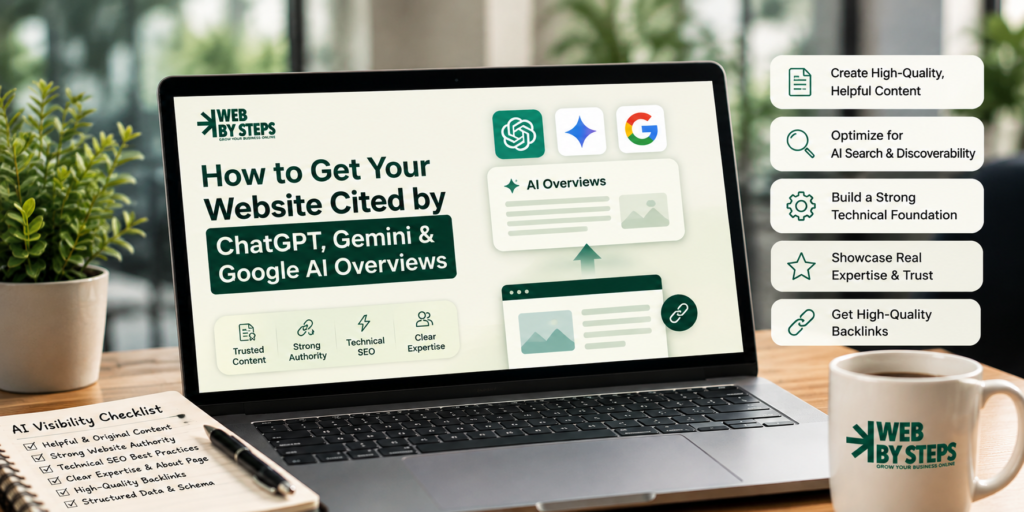
Quick answer: To get cited by ChatGPT, Gemini, and Google AI Overviews, you need a fast, technically clean website, content written in a clear “question → direct answer” format, structured data (schema markup) that tells AI exactly what your page is about, and real mentions of your brand across trusted third-party sites. This new practice is called Generative Engine Optimization (GEO) and it is quickly becoming as important as traditional SEO.
Ten years ago, if you wanted people to find your business online, you optimized for Google. You picked the right keywords, built backlinks, and hoped for a spot on page one. Simple.
Today, something bigger is happening. People are not just “Googling” anymore they are asking. They open ChatGPT and type, “Who’s a good web development company near me?” They ask Gemini to “compare the top SEO agencies.” They search on Google and get an AI Overview answer at the very top of the page, before any blue links even show up.
If your website isn’t built to be read, understood, and quoted by AI, you become invisible in these answers even if you’d normally rank #1 on Google.
This guide breaks down, in plain and simple language, exactly how to fix that.

What Is GEO, and Why Should You Care?
Think of it like this: imagine your favorite teacher, instead of pointing you to ten different textbooks, just tells you the answer directly — and mentions which book they got it from. That’s exactly what ChatGPT, Gemini, and Google AI Overviews do now. They read hundreds of websites in seconds, pick out the best facts, and hand the user one clean answer with a source link (a “citation”).
Generative Engine Optimization (GEO) also called Answer Engine Optimization (AEO) is the practice of shaping your website so AI tools choose your page as that trusted source.
Here’s why this matters for your business right now:
- AI Overviews already appear on a large share of Google searches, often showing up before any traditional search result as AI Overviews now appear on more than 40% of Google searches.
- People are splitting their questions across multiple AI tools ChatGPT, Gemini, Claude, and Perplexity each pull answers from a different index, so a business only optimized for classic Google SEO is quietly missing a growing chunk of buyers.
- Being “cited” by AI is the new version of ranking #1. A mention inside an AI-generated answer puts your brand name directly in front of a customer who is actively looking to buy no click required to build trust.
In short: if your competitor’s blog gets quoted inside ChatGPT’s answer and yours doesn’t, they win the customer before you even get a chance.
How Do ChatGPT, Gemini, and Google AI Overviews Actually Pick What to Cite?
Each AI tool works a little differently, kind of like three different judges scoring the same competition using slightly different rules.
| AI Engine | How It Finds Sources | What It Rewards |
|---|---|---|
| Google AI Overviews / AI Mode | Pulls from Google’s regular search index, powered by Gemini | Strong classic SEO roughly 75% of AI Overview links come from pages already ranking in the top 12 organic search results |
| ChatGPT | Uses real-time web search for current questions | Clear, well-structured pages that directly answer a specific sub-question |
| Gemini (in Search) | Uses “grounding” a live Google Search lookup layered under the AI answer | Pages with clean, section-level answers; Gemini can cite a single well-written section (H2) even inside a much longer page |
| Perplexity | Runs its own independent web index | Fresh, fact-dense pages with clear sourcing |
Interesting twist: getting cited by AI is no longer the same game as classic SEO.One industry analysis found that only around 17–38% of AI Overview citations also appear in Google’s own top-10 organic results down sharply from about 75% just eighteen months earlier. Translation: ranking well used to guarantee an AI citation. Now you need to actively earn it with content built for extraction, not just ranking.
The 7 Steps to Get Your Website Cited by AI
1. Answer the Question in the First 2–3 Sentences
AI models love a clear, upfront answer the same way you’d want your friend to just tell you the movie’s plot instead of taking ten minutes to get there. Marketers call this the “Bottom Line Up Front” (BLUF) method: open every important section with a tight 40–60 word answer, then explain the details below it.
Example:
“There are many things to think about when choosing a web development company, and it really depends on your goals, your budget, and a few other factors, but generally speaking…”
“The best web development company for a small business is one that hand-codes your site (instead of using slow templates), guarantees fast load speed, and gives you direct access to your developer not just a project manager.”
2. Structure Your Content Like a Roadmap, Not an Essay
Around 80% of pages currently cited by AI systems use lists, tables, or other structured elements instead of long, wandering paragraphs. AI tools are essentially skimming for “extractable” chunks of information give them clean chunks to grab.
- Use question-style headings (H2/H3) e.g., “What does a website revamp cost?” instead of “Pricing Overview”
- Break processes into numbered steps
- Put comparisons into tables
- Keep each paragraph focused on one idea
3. Add Numbers, Dates, and Specifics Not Vague Claims
AI models prefer facts they can verify and reuse confidently. A vague sentence like “our clients saw great results” is nearly useless to an AI. A sentence like “clients saw a 40% increase in mobile page speed after their site was rebuilt in 2026” gives the AI something concrete to quote.
4. Use Schema Markup (Structured Data)
Schema markup is like a name tag for your content it tells search engines and AI systems exactly what each piece of your page is (an article, a product, a review, a question-and-answer) instead of making them guess.
Pages with FAQ schema, Article schema, and Organization schema give AI tools a much clearer, machine-readable map of your content — which is one of the fastest, most technical wins a business can make. (We’ve included a ready-to-use schema example later in this article.)
5. Earn Mentions on Other Trusted Websites
Here’s a stat that surprises most business owners: brands are roughly 6.5 times more likely to get cited through third-party sources publications, reviews, and forums than through their own website.
That means your website content is only half the job. The other half is being talked about elsewhere:
- Getting listed in industry directories and review platforms
- Being featured or quoted in local news or industry blogs
- Collecting genuine Google reviews and testimonials
- Getting mentioned by partners, suppliers, or past clients online
6. Keep Your Content Fresh
AI systems treat “recency” as a trust signal. Pages refreshed on a quarterly basis have been shown to earn significantly more referral traffic from ChatGPT than static, untouched pages. Revisit your key pages every few months: update statistics, refresh screenshots, and make sure any “as of [year]” references are current.
7. Make Sure AI Bots Can Actually Read Your Site
This is the step most businesses miss entirely. If your website is slow, blocks the right bots, or is built on heavy, bloated page-builder code, AI crawlers may struggle to read it properly no matter how good your writing is.
- Check that your
robots.txtfile allows web-search crawlers (like OpenAI’s search bot) to access your content - Make sure your site loads fast slow, plugin-heavy sites hurt both regular SEO and AI crawlability
- Use clean, semantic HTML instead of complex drag-and-drop page-builder code that buries your actual content in messy markup

This is exactly where Web By Steps comes in. We hand-code every website with clean, semantic HTML5 and lightweight code no bloated templates, no 8MB plugin stacks. Our sites are built for sub-second load times and Core Web Vitals Pass scores of 99/100, which means both Google and AI crawlers can read, index, and cite your content without friction. Our SEO & Search Visibility service already includes automated schema markup and technical SEO audits the exact foundation GEO is built on.
A Little AI Touch: How You Can Use AI to Get Cited by AI
Here’s the fun part you can use AI tools themselves to prepare your website to be cited by AI. It’s a bit like using a calculator to check your calculator’s math, and it genuinely works:
- Ask an AI to audit your content for “fact density.” Paste a page into ChatGPT or Claude and ask: “Rewrite this paragraph so the first sentence directly answers the reader’s question.” This trains you to spot vague writing fast.
- Generate FAQ questions the way real customers would ask them. Ask AI: “What are 10 real questions a small business owner might type into ChatGPT about [your service]?” Then answer those exact questions on your page.
- Draft your schema markup with AI, then verify it. AI tools are excellent at generating the JSON-LD code structure for FAQ or Article schema in seconds — just always test it afterward using Google’s Rich Results Test before publishing.
- Run your own brand through AI search monthly. Literally ask ChatGPT and Gemini, “Who are the best [your industry] companies in [your city]?” and see if you show up. If you don’t, that’s your content gap to fix next.
Is this relevant for a small business? Absolutely you don’t need a huge marketing team to do this. A single afternoon spent restructuring your top 5 pages with AI’s help can meaningfully move the needle on whether AI tools start mentioning your brand.

GEO vs. Traditional SEO: You Need Both
A common myth is that GEO replaces SEO. It doesn’t it builds on top of it. Since a large share of AI Overview citations still come from pages already ranking well organically, a technically weak, slow, unranked website has almost no shot at being cited by AI either. Think of SEO as the foundation of a house, and GEO as making sure the house is furnished in a way that guests (AI tools) instantly understand and want to describe to others.
| Traditional SEO | GEO (AI Citation Optimization) | |
|---|---|---|
| Goal | Rank high on the search results page | Get quoted directly inside the AI’s answer |
| Core Focus | Keywords, backlinks, page speed | Clarity, structure, fact-density, schema |
| Success Metric | Click-through rate, ranking position | Citation frequency, brand mentions in AI answers |
| Still Needed? | Yes the foundation | Yes the amplifier |
Final Thoughts: Start Small, Start Now
You don’t need to overhaul your entire website overnight. Start with your three most important pages probably your homepage, your services page, and your best-performing blog post. Rewrite the opening of each section using the BLUF method, add a clear FAQ section, and make sure your technical foundation (speed, clean code, schema) is solid.
If your current website is built on a slow, bloated platform, no amount of clever writing will save you the AI crawlers simply won’t be able to read it properly. That’s where a clean, custom-coded rebuild makes the real difference.
Ready to make your website visible to Google, ChatGPT, and Gemini all at once? Talk to Web By Steps about a free AI & SEO visibility audit we’ll show you exactly where your site is losing citations, and fix it, step by step.